
The county beyond the coach route
Most visitors to Kerry follow a narrow corridor: Killarney, the Ring of Kerry, the Dingle Peninsula, out again. It is a fine corridor and there is a reason it exists. But it leaves out the north of the county entirely, skirts the inland towns, and gives a curiously incomplete picture of a place where most people live and work somewhere other than a scenic viewpoint.
The smaller towns are not substitutes for the coast. They are a different thing: working market towns with their own festivals, their own accents and their own reasons for being where they are. Half a day given to one of them usually returns more than another headland.
Listowel: a town that takes writing seriously
Listowel sits in north Kerry on the River Feale, in flat, rich farming country that looks nothing like the mountains an hour to the south. It is a market town of a very particular kind, arranged around a large square with a ruined castle at one end, and it has an unusually strong claim to be a literary place.
The literary tradition
That claim is not marketing. Listowel produced a remarkable cluster of writers in the twentieth century, most famously a playwright who also kept a pub on the main street and whose plays about rural Irish life are still staged constantly. The town runs a long-established writers’ festival in early summer, built around workshops, readings and a good deal of talk in bars, and it draws people who write rather than only people who read. Dates, programme and format vary from year to year, so check the current listings rather than assuming.
There is a literary and cultural centre in the town devoted to the writers of the district, and a theatre and arts centre housed in a former church on the square that programmes year-round. The result is a town of modest size with a genuine cultural calendar, which is rarer than it should be.
The rest of the town
Look up at the shopfronts. Listowel is known for elaborate decorative plasterwork on its buildings, the work of a local craftsman, and once you notice the moulded figures and lettering you will see them all along the street. The castle ruin in the square is medieval and open seasonally. And on the edge of town there is a reconstruction of the Lartigue monorail, an eccentric single-rail railway that once ran to the coast at Ballybunion and existed nowhere else in Ireland; a short demonstration line runs in season.
The other thing to know about Listowel is the autumn racing festival, a harvest meeting that effectively takes over the town for a week. If you want to see a Kerry town at full volume, that is the week. If you want a quiet visit, it is emphatically not.
Fenit: the harbour west of Tralee
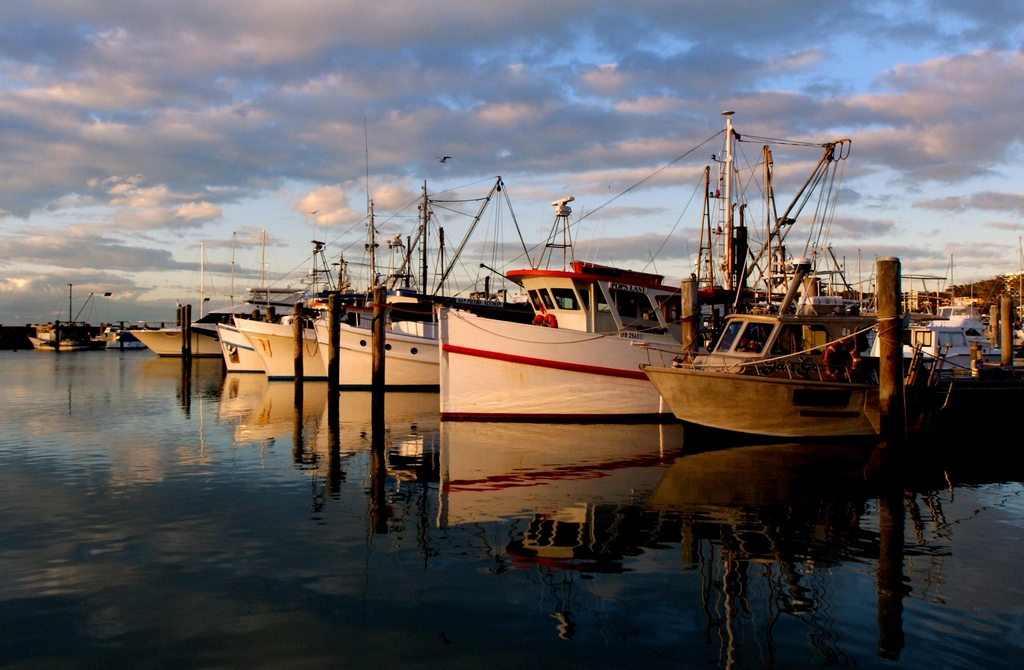
Fenit is a small working harbour on Tralee Bay, a short drive west of Tralee. It has a pier, a marina, a lifeboat station, a beach and a handful of bars and restaurants, and on a good evening it is one of the pleasanter places in the county to eat outdoors and watch the light go off the water towards the Slieve Mish mountains.
The greenway
The most useful thing about Fenit for a visitor is that you can get there from Tralee without a car. A greenway follows the line of a former railway from the edge of Tralee out to the harbour, flat, traffic-free and suitable for families and casual cyclists. It passes the ship canal and the restored windmill at Blennerville on the way, which makes for a natural halfway stop. Bicycles can be hired in Tralee, and the round trip is an easy half-day. This is the single best answer to the question of what to do in Tralee with children and indifferent weather.
Saints and lifeboats
Fenit is traditionally associated with the birth of St Brendan the Navigator, the sixth-century monk whose legendary Atlantic voyage is one of the great stories of early Irish literature, and there is a striking statue of him near the harbour. The tradition is old, the historical detail is uncertain, and the sculpture is worth the walk regardless.
Castleisland and the inland towns
Castleisland sits inland on the main road between Tralee and the Limerick direction, and it is the sort of town that visitors drive through while looking for somewhere else. It is a farming and market town with a notably broad main street — locals will tell you it is among the widest in Ireland — a ruined thirteenth-century castle that gave the place its name, and a long history of limestone quarrying in the surrounding countryside.
The main visitor attraction nearby is a show cave, a genuinely impressive limestone system opened to the public with guided tours, which is one of the few wet-weather options in the county that improves in rain. Beyond that, the town’s appeal is that it is unselfconscious. Shops serve locals, pubs are pubs, and prices are what people who live there will pay.
The same is true of the other inland towns of the county — the small places along the Cork and Limerick roads where nothing is arranged for visitors. If you want to understand what Kerry is like when the season ends, this is where to look.
Killorglin and Kenmare
Two towns on the Ring of Kerry deserve to be treated as destinations rather than as places you pass.
Killorglin, on the River Laune, hosts one of the oldest fairs in Ireland every August, at which a wild goat is brought down from the mountains and crowned king over the town for the duration. It is genuinely ancient in origin, genuinely strange, and completely unlike a manufactured heritage event. The town is packed and the trading, music and drinking run late. Check current dates and book accommodation well in advance if you intend to be there.
Kenmare is a planned town, laid out deliberately in the eighteenth century, and it shows in the clean triangle of its streets. It has an old lace-making tradition, a stone circle within walking distance of the centre, and a concentration of good restaurants that is disproportionate to its size. It also makes an excellent base for the Beara and Iveragh peninsulas, and it is quieter than Killarney without being remote.
North Kerry: Ballybunion, Ardfert, Tarbert
North of Tralee the county changes character. Ballybunion is a traditional seaside resort with big beaches, a dramatic cliff walk and a famous golf links, busy in summer and cheerfully empty out of season. Ardfert has the ruins of a substantial medieval cathedral on an early church site associated with St Brendan, and it is one of the more atmospheric monastic ruins in the county precisely because so few people stop.
Further north again, Tarbert sits on the Shannon Estuary, and this is worth knowing for practical reasons: a car ferry crosses the estuary from here to County Clare, which turns a long drive around through Limerick into a short crossing. It is a far more pleasant way to move between the west-coast counties. Check current timetables and fares before relying on it.
Making the detours work
- Go on a market or fair day if you can. A country town on its busy day tells you more in an hour than a week of scenic driving. Ask locally which day that is; it varies.
- Eat where the car park is full of vans. Inland towns still keep proper day-time eating houses serving a substantial lunch at a fair price, which is increasingly rare on the tourist coast.
- Check opening before you drive. Small-town attractions, castles and heritage centres frequently run seasonal or reduced hours, and a phone call saves an hour of driving.
- Use the towns as bases, not just stops. Accommodation in Listowel, Castleisland or Tralee is generally cheaper and easier to book than in Killarney, and the driving distances in Kerry are short.
- Let the festival calendar decide your dates. Between the literary weekend, the harvest races, the August fair and dozens of smaller events, there is nearly always something on somewhere. Check current listings, because dates move.
- Allow for slow roads. Inland Kerry runs on narrow roads with tractors, and journey times bear little relation to what a mapping app predicts.