
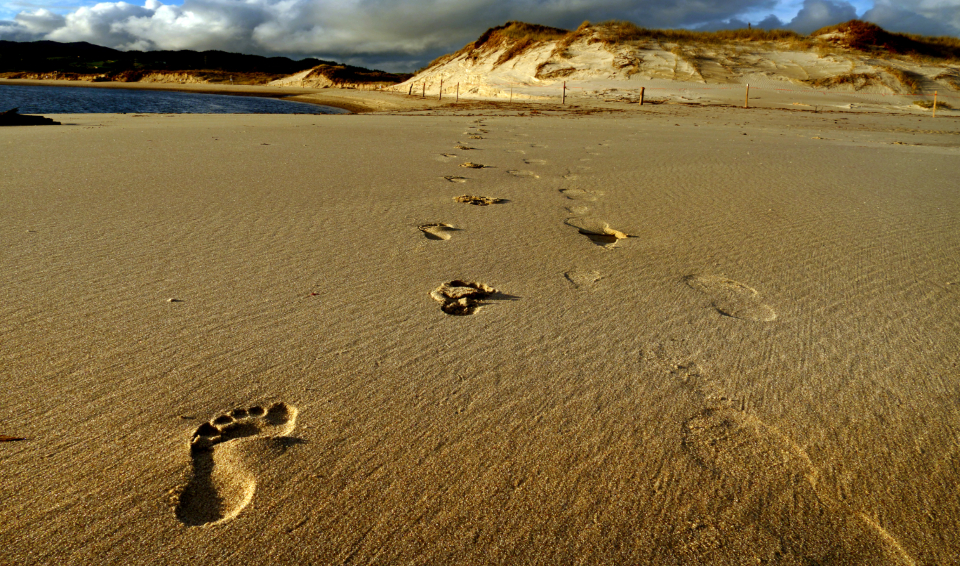
Kerry’s beaches, and the sea that comes with them
Kerry has a great deal of sand. Tralee sits within half an hour of several kilometres of open Atlantic strand, and the peninsulas beyond hold dozens more, from wide dune-backed beaches you can walk for an hour to small coves reached down a farm track. What Kerry does not have is a gentle sea. The water here is cold, exposed and genuinely powerful, and the difference between a good day at the beach and a bad one usually comes down to understanding that.
The big strands near Tralee
Banna
Banna Strand runs north from Tralee Bay behind a long line of high dunes and is the closest large beach to the town. It is enormous, and even on a warm Sunday the crowd concentrates near the car parks and thins out within ten minutes of walking. The dunes are fragile and fenced in places; use the marked accesses rather than scrambling through them.
Banna faces west into the open Atlantic, which means proper surf on most days and a shore break that can knock an adult over. It has lifeguard cover in the summer season at designated areas. Swim between the flags there and treat the unpatrolled kilometres either side as a walking beach.
Inch
Inch is a long sand spit reaching out into Dingle Bay from the southern shore of the Dingle Peninsula, about forty minutes from Tralee. It is one of the most photographed beaches in Ireland, and the reason is the shape: a straight run of hard sand with mountains rising on both sides of the bay.
Cars are permitted to drive onto part of Inch, which some people love and others find ruins it. Drive slowly if you do, stay on the firm sand, and be aware that vehicles do get stuck and do get caught by the tide. Inch is a popular surf beach with schools operating in season, and it also has seasonal lifeguard cover.
Ballybunion
Ballybunion is up in north Kerry, an hour or so from Tralee, and is a proper old-fashioned seaside town with two beaches divided by a headland and a ruined castle. It is a livelier, more built-up experience than the west Kerry strands — amusements, chip shops, a golf links with a serious reputation — and it is all the better for people who want a beach day rather than a wilderness.
The cliffs and sea caves either side of the town are worth the walk.
The smaller strands
Beyond the well-known names, Kerry is full of small beaches that never appear on a list, and they are often the better option in August. A few worth knowing about:
- Fenit and the inner bay. Close to Tralee, sheltered, and much calmer than the open coast. A reasonable option with young children when Banna is too rough.
- The north Dingle beaches. Around Castlegregory and the Maharees, a series of strands facing in different directions, which means there is usually one out of the wind whatever it is doing.
- Coumeenoole, near Slea Head. Spectacular to look at, backed by steep grass, and unsuitable for casual swimming because of exposure and current. Go for the view.
- Derrynane, on the Ring of Kerry. Sheltered, with a tidal island you can walk to on a low tide, dunes and woodland behind. One of the best all-round beach days in the county.
- Rossbeigh. A long spit opposite Inch across the bay, backed by dunes, with a hard-sand section that walks for miles.
Cold water, honestly
The sea off Kerry is cold all year. It warms modestly through the summer and reaches its highest temperatures in late August and September, which is why the best swimming month is not the same as the warmest air month. Even at its warmest, this is water that will take your breath away on entry.
Cold water shock is the real hazard, and it is not about hypothermia. Sudden immersion in cold water triggers an involuntary gasp and rapid breathing, and if your head goes under during that gasp you inhale water. It affects fit, competent swimmers as much as anyone.
- Enter slowly and deliberately. Wade in, let your breathing settle before you commit, and do not jump or dive into cold water from a height.
- Never swim alone. Even in shallow water, and particularly on an unpatrolled beach out of season.
- A wetsuit changes everything. It buys you time, warmth and buoyancy, and it is why local swimmers stay in the water in April.
- Get warm properly afterwards. Dry clothes, a hat and a hot drink. The chill can deepen for twenty minutes after you leave the water.
- Alcohol and cold water do not mix. A significant share of drownings involve drink. Leave it until afterwards.
Reading a beach before you get in
Rip currents are the other serious hazard, and they exist on every one of Kerry’s open Atlantic beaches. A rip is a narrow channel of water flowing back out to sea, and it can move faster than you can swim. It does not pull you under; it pulls you out.
Learning to spot one takes five minutes and is worth more than any amount of general caution.
- Look for the gap in the breaking waves. A rip often shows as a calmer, darker channel running seaward through a line of white water. The flat bit is not the safe bit.
- Look for churned, sandy water. A plume of discoloured water moving offshore is a strong sign of an outgoing current.
- Watch for a few minutes from higher ground. From the dunes or a car park above the beach, the pattern is far more obvious than it is at sea level.
- If you are caught, do not swim against it. Float, keep your head above water, and either signal for help or swim parallel to the shore until you are clear of the channel before turning in.
- Check the tide. Several Kerry beaches have sandbars, spits and tidal islands that are safe on a falling tide and dangerous on a rising one.
Where a beach is patrolled and flagged in summer, swim between the flags. The flags are placed where the lifeguards have judged the conditions to be manageable, and they move during the day for a reason.
The coast in winter
Kerry’s beaches out of season are, for a lot of people, better than the beaches in it. Banna in January, with a gale coming in off the Atlantic and spray blowing off the tops of the breakers, is a genuinely dramatic place, and you will share several kilometres of it with two dog walkers and a heron.
Winter storms rearrange these beaches. Sand shifts, cliff edges go, and material is stripped from one end of a strand and dumped at the other.
Some cautions apply, and they are not trivial. There is no lifeguard cover outside the summer season anywhere. Big swell means the sea reaches much further up the beach than you expect, and people are swept off rocks and low cliffs in Ireland every winter by waves they were watching rather than avoiding. Stay well back from the water on a storm day, keep off exposed rock platforms and piers entirely, and be aware that a single larger set can arrive after twenty minutes of smaller ones.
Daylight is short from November to February, so a coastal walk needs an earlier start than it feels like it should. Take a head torch if you are out late in the afternoon, and check the tide before committing to a beach with cliffs behind it — being cut off is an easy mistake and a serious one.
Making the most of a beach day
The best beach days in Kerry are rarely the hottest ones. A bright, breezy afternoon in late May, with the tide dropping and the sand hard enough to walk on for miles, beats a still August Sunday with a full car park. Check the tide tables, pick a beach that faces away from the wind, take more layers than you think you need, and expect the weather to change at least twice.
And take the swim if the conditions are right. Cold Atlantic water is not comfortable, but the twenty minutes afterwards, walking back up the sand feeling entirely awake, is one of the reliable pleasures of this coast.
Read next: Things to Do in Killarney, Ireland: Lakes, Trails and the Town Itself