
What Kerry actually holds
Ireland has a thin mammal list by continental standards, and visitors sometimes arrive expecting more than the island can offer. What Kerry has instead is concentration: a nationally important deer herd in an old oak and yew woodland, some of the most significant seabird colonies in the North Atlantic a few kilometres offshore, and a stretch of coast where whales and dolphins are seen often enough to support a proper watching culture. Set your expectations towards those and the county delivers repeatedly.
Almost all of it rewards patience rather than distance travelled. The visitor who sits still for an hour at the edge of a wood or on a headland sees far more than the one who drives between five viewpoints.
Red deer, and how to watch them properly
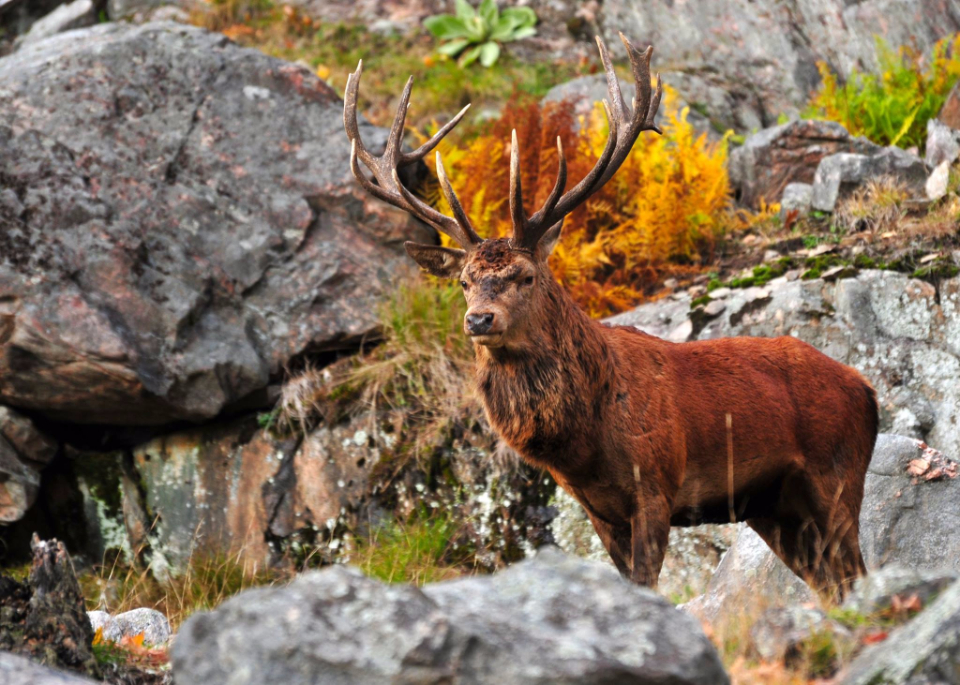
The red deer of Killarney are the reason many naturalists come to Kerry at all. This is Ireland’s only native red deer herd, descended from animals that have been here since the wild returned after the last glaciation, and it is a genuinely significant population rather than a scenic amenity. The park also holds sika deer, introduced in the nineteenth century, and the risk of hybridisation between the two is a long-standing conservation concern.
You will most reliably see red deer on open ground within Killarney National Park at the quiet ends of the day. Dawn and the last hour of light are far better than midday, when the animals move into cover. Binoculars matter more than proximity.
The rut
In autumn the stags gather harems and roar, and the sound carries a long way across the valleys. It is one of the great wildlife experiences available in Ireland and it is also the time of year to be most careful. Rutting stags are large, powerfully built and unpredictable, and they will not reliably move away from a person who approaches. Keep well back, stay on paths and open ground where you have an escape route, and never place yourself between a stag and his hinds. If a stag turns to face you, you are too close.
Disturbance you may not notice
Deer that keep lifting their heads, stop feeding, or begin walking away are already disturbed, even though nothing dramatic has happened. Repeated disturbance costs animals feeding time and, in winter, condition. Watch for those signals and back off before the animals have to move. Dogs must be under proper control near deer at all times, and there are places and periods where they should not be brought at all.
The woodland cast
Killarney’s woodlands are the other reason to slow down. These are among the largest surviving areas of native oak woodland in Ireland, along with a rare yew wood, and they support a suite of animals that are hard to see anywhere.
Red squirrels are present and reasonably findable in the conifers and oaks if you watch the canopy at first light. Pine martens have recovered strongly across Ireland in recent decades and are occasionally seen at dusk. Otters use both the lake shores and the rivers, and a still evening on a quiet stretch of water is your best chance. The woods also hold the Kerry slug, a legally protected and genuinely unusual creature restricted to this corner of Ireland and northern Iberia, which is worth knowing about even if hunting for slugs is not your holiday.
Overhead, white-tailed eagles have been reintroduced to the area since the 2000s and now breed in the south-west. Seeing one over the lakes is a real possibility, though not something to plan a day around. Ask locally, and check the national park’s current information, since nest sites and viewing advice change from season to season.
Seabirds and the cliffs
The islands off the Iveragh Peninsula hold seabird colonies of international importance. Little Skellig carries one of the largest northern gannet colonies in the world — from a boat, the rock appears whitewashed and the air above it is thick with birds. Landing there is not permitted, and none is needed; the spectacle is entirely visible from the water.
Skellig Michael, its neighbour, combines the early monastic site with breeding puffins, storm petrels, Manx shearwaters and guillemots. Puffins are present through the breeding season roughly from spring into midsummer and are gone by late summer, so a trip in August will show you the island but not the birds people expect. Landings are licensed, limited in number, restricted by season and cancelled routinely for sea conditions. Book far ahead, accept that a cancellation is likely at some point, and treat the eco-tour trips that circle the islands without landing as a genuinely good alternative rather than a consolation.
Birds you can see without a boat
You do not need to go offshore. The sea cliffs of the Dingle and Iveragh peninsulas carry fulmars, kittiwakes, guillemots and razorbills in season, and the red-billed chough — a crow with a curved red bill and a distinctive call, scarce across most of Europe — is a characteristic bird of these coasts. Estuaries and the shallow bays hold waders and wildfowl in winter, and the Tralee area in particular is worth a look in the colder months when the cliffs have gone quiet.
Whales and dolphins
All Irish waters were declared a whale and dolphin sanctuary decades ago, and the south-west coast is where that means most to a visitor. Common dolphins, bottlenose dolphins and harbour porpoise are seen through much of the year. Minke whales are generally a summer and autumn presence. The larger baleen whales, including fin and humpback whales, are more associated with the later part of the year off the south-west, and basking sharks appear in spring and early summer. All of this varies with where the prey is, which changes from year to year.
Boat or headland
Dedicated wildlife boat trips run from several Kerry harbours in season and are the more reliable option, particularly if the skipper is experienced at finding animals rather than simply running a sightseeing route. Land-based watching from a headland with binoculars is free, unhurried and surprisingly productive on a calm day with good light behind you. The Irish Whale and Dolphin Group collects and publishes sightings and offers a code of conduct for watching, which is the sensible place to check what is currently being seen.
One honest note: Dingle’s celebrated solitary dolphin, who lived in the harbour for decades and drew visitors from around the world, has not been seen since 2020. Boat trips from the town now focus on the wider bay and its wildlife, which is a different and less guaranteed proposition.
Seals and the shoreline
Grey and harbour seals use Kerry beaches, sandbanks and rocky islets to rest, moult and pup. A seal hauled out on sand is not stranded and does not need help; it needs to be left alone. Give any seal a wide berth on land, keep dogs away entirely, and never place yourself between an animal and the water. Pups on beaches in the autumn and winter months are usually where their mother left them. If an animal looks genuinely sick or injured, contact a seal rescue organisation rather than intervening yourself.
Watching without doing harm
- Use optics instead of closing the distance. A modest pair of binoculars changes everything and removes almost every reason to approach an animal.
- Read the animal, not the rulebook. If it has stopped what it was doing and is looking at you, you are too close, whatever the recommended distance says.
- Keep dogs under control everywhere. Ground-nesting birds, seals, deer and sheep are all vulnerable to a loose dog, and the consequences for the dog can be serious too.
- Do not fly a drone near wildlife. Drones cause severe disturbance to seabird colonies and seal haul-outs, and their use is restricted in national parks and near protected sites.
- Never feed wild animals. Fed animals lose wariness, congregate unnaturally and often end up dead or destroyed.
- Choose operators who talk about limits. A good skipper will tell you what they will not do around animals. That is the one you want.
- Report what you see. Casual sightings submitted to national recording schemes are genuinely useful data, and it costs a few minutes on a phone.