
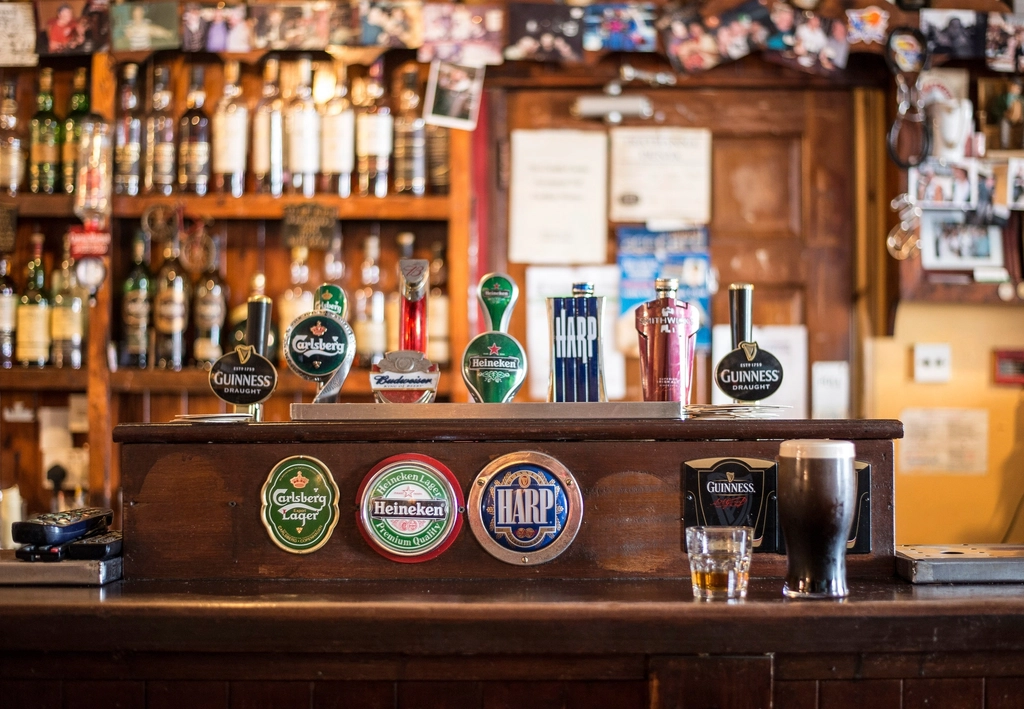
A town that drinks and eats for itself
Tralee has a real advantage over the better-known tourist towns of Kerry, and it is a simple one: most of the people in its pubs and restaurants on an ordinary evening live here. This is a county town with a hospital, a university campus, county offices, a large agricultural hinterland and a young population, and its eating and drinking reflects that rather than reflecting a coach schedule. Prices are ordinary. Nobody performs Irishness at you. The trade-off is that Tralee has fewer showcase restaurants than Killarney or Dingle, and that its music, when it is good, is harder to find because it is not advertised.
What follows is how to find the good of it without wasting evenings, and how to conduct yourself once you have.
The pub session tradition
Traditional Irish music in a pub comes in two broadly different forms, and confusing them is the commonest visitor mistake.
The session
A session is a group of musicians sitting in a corner playing for each other. There is no stage, no amplification, no set list and no performance in the theatrical sense. Tunes are started by whoever fancies one; the others join if they know it. There will be long gaps for talk and drink. Nobody announces anything. Musicians drift in and out over the evening, and the shape of the night is decided by who turns up. A good session is one of the great things in Irish life and it is essentially a private activity that you are permitted to overhear.
The trad gig
The other form is a booked act: two or three musicians, often with a singer, amplified, on or near a small stage, playing a mix of tunes and well-known songs with some patter between them. This is a performance for an audience, and there is nothing wrong with it. It is reliable, it starts at an advertised time, and it will include the songs visitors hope to hear. But it is not a session, and people who go home saying they heard a great session usually heard one of these.
How to find a real session in Tralee
- Ask a musician, not a poster. Sessions move. A pub that had a Tuesday session for years may not have one now, and a new one may have started three streets away. Anybody carrying an instrument case, or working behind a bar that has a fiddle on the wall, will tell you straight.
- Ask about the night, not the pub. The question that gets a useful answer is not where is there music, it is where is there a session on a Wednesday. Sessions are tied to particular nights and particular people.
- Go late and stay. A session advertised for nine will rarely be going properly before ten, and often peaks close to midnight. Arriving at half nine and leaving at ten because nothing is happening is how most visitors miss it.
- Try the older, plainer pubs. Sessions tend to live in bars that have not been refitted recently, where there is a corner with a table and enough space for six chairs. A large modern bar with several screens is a different kind of place.
- Avoid festival week if this is your aim. August brings crowds, volume and booked entertainment. The quiet season — roughly October to May — is when the ordinary weekly sessions are at their best.
How to behave in a session
None of this is complicated, but getting it wrong is noticed.
- Do not talk over the music at the musicians’ table. Conversation elsewhere in the bar is normal and fine. Loud talk right beside the players is not, and neither is standing over them.
- Do not request songs. A session is not a jukebox and the players are not being paid to take orders. If you must, wait for a break and ask politely, and accept no.
- Do not clap after every tune. Some applause happens, especially for a song, but relentless clapping between tunes marks the room out as an audience and changes what the players do. Follow the locals.
- Be quiet for a song. When somebody sings unaccompanied, the room goes silent. Genuinely silent. This is the strictest rule in the whole culture and the one visitors most often break.
- Ask before you join in. If you play, bring your instrument by all means, but ask the musician who seems to be anchoring the session, sit in, listen for a good while, and do not lead until invited.
- Buy the musicians a drink. Many sessions are paid little or nothing. A round sent over is the normal courtesy and is always well received.
What to expect of a trad night generally
Expect it to start later than advertised. Expect long instrumental stretches of reels and jigs that sound similar until you have heard a few hundred, at which point they stop sounding similar. Expect singing, sometimes in Irish. Expect the room to be warm and the seating inadequate. Expect that the best twenty minutes may come after you had planned to leave.
Expect also that some nights are simply flat. Two musicians turn up instead of six, or the room is wrong, or nobody is in form. That is the honest cost of the real thing rather than the booked version. If you have only one evening, a booked trad night is the safer choice; if you have three, spend one of them looking for a session.
Local food worth seeking out
Kerry food is not fussy and its strengths are raw materials rather than technique. Tralee is a market town in a county of dairy, sheep and small boats, and the things worth eating reflect that.
From the land
Kerry lamb, particularly hill lamb off the mountain grazing, is the county’s best-known meat and appears on menus through the season. Beef and dairy are everywhere: this is butter and buttermilk country, and it shows in the baking. Brown soda bread made with buttermilk is served with almost everything and varies enormously from place to place, which is part of the pleasure. Black and white pudding from the small butchers of the peninsula villages is a genuine local speciality and turns up at breakfast, in salads and alongside scallops in more ambitious kitchens.
From the sea
Fenit is a working harbour a short distance away, and the Dingle and north Kerry boats land within an hour. Seafood chowder is the reliable everyday dish — thick, milky, full of smoked and white fish — and is a fair test of any kitchen. Beyond that, look for crab claws in garlic butter, mussels, prawns and whatever whitefish is written on a board rather than printed on a menu. Oysters and periwinkles appear in season.
Where to look
- The butchers and bakeries in the centre. Tralee still has independent food shops on its main streets, and they are the cheapest way to eat well: bread, pudding, cheese, and a bench in the Town Park.
- The farmers’ market. A weekly market brings in producers from around the county with vegetables, baking, preserves and cheese. The day and location have shifted over the years, so confirm locally.
- Pub food at lunchtime. Many Tralee pubs serve a straightforward carvery or lunch menu that is far better value than dinner and is what local workers eat.
- Menus that change. The single most useful signal in any Kerry town is whether the fish list is fixed or written up daily. Daily means it came off a boat this week.
Practical rhythms of a Tralee evening
Kitchens in Irish county towns close earlier than visitors from continental Europe expect; aiming to sit down after nine is risky outside high summer, and booking is sensible at weekends. Pubs, by contrast, run late, and the gap between eating and music is usually filled with a slow drink somewhere quiet. Sunday and Monday are the thinnest nights of the week for both food and music, and midweek in winter can be very quiet indeed.
None of this makes Tralee a difficult town for an evening. It makes it an ordinary Irish one, which is precisely its appeal: you are not being catered to, you are being included. Walk in, sit at the bar, order slowly, and let somebody ask you where you are from. That is generally when the evening actually starts.