
A county with the past lying about in the fields
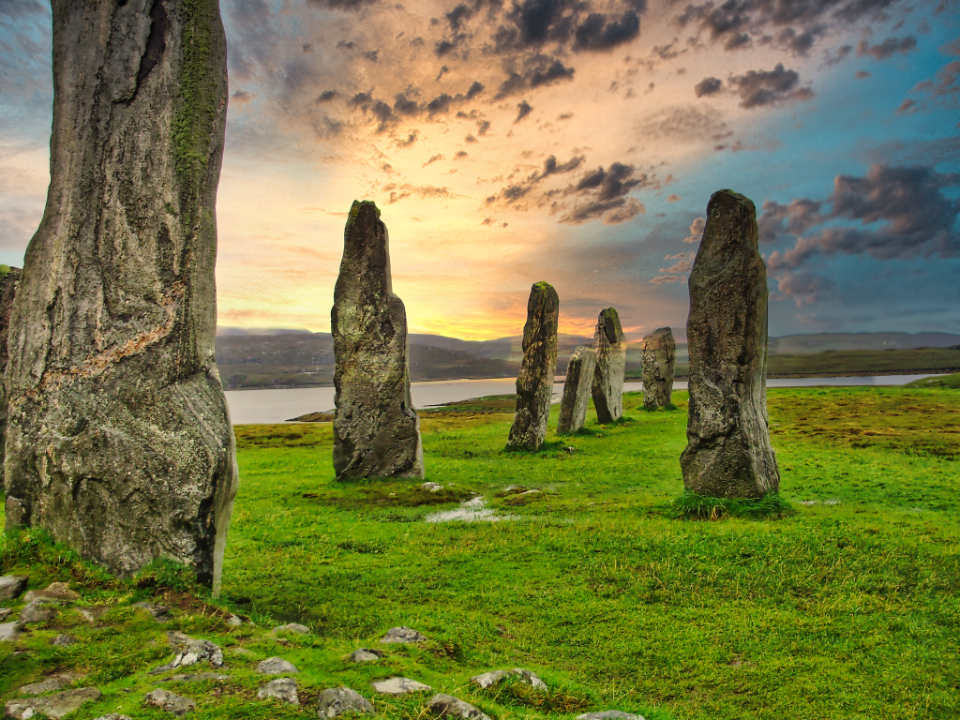
Drive the western peninsulas of Kerry with the archaeological survey open beside you and the effect is faintly comic. There are circular earthworks in the pasture, standing stones in the ditch, small stone cells on the hillside, a ruined church in a graveyard, and a farmer moving cattle past all of it without a second glance. Kerry is one of the densest concentrations of surviving early monuments in Ireland, and much of it sits on ordinary working land rather than in fenced-off heritage sites.
Understanding what you are seeing takes surprisingly little effort. Four or five categories cover the great majority of it, and once you can name them the landscape starts to read as a sequence of settlements, burials and prayer rather than as a scatter of anonymous stones.
Ring forts: the commonest thing in the field
The single most abundant monument type in Ireland is the ring fort, and Kerry has them by the thousand. Despite the name, most were not military. They were enclosed farmsteads — a house and its outbuildings inside a circular bank or wall, keeping stock in and wolves and raiders out. The great majority are thought to belong to the early medieval centuries, broadly the second half of the first millennium, though occupation at some sites runs earlier and later.
Rath and cashel
Two variants dominate. A rath is built of earth: a circular bank thrown up from an external ditch, now often reduced to a low grassy ring with a fringe of thorn trees. A cashel or caher is the same idea in dry stone, and in stony west Kerry these survive far more visibly. The best-known examples in the county are substantial structures with thick walls, internal stairways and terraces, and standing inside one gives an immediate sense of enclosure and of how small the inhabited world was.
How to read one in the field
Look first for the entrance, usually a gap facing east or south-east away from the prevailing wind. Look for whether the bank is inside or outside the ditch: a bank inside a ditch is defensive in intent, whereas the reverse suggests something else. Look for internal features — a raised platform where a house stood, the outline of a smaller enclosure, souterrains or underground passages showing as a depression. And look at the siting. Ring forts are almost always on well-drained ground with a good view and reasonable land around them, which is a reminder that these were farms chosen by farmers.
Ogham stones: the first written Irish
Ogham is the earliest form of writing in the Irish language, cut into standing stones in roughly the fourth to seventh centuries. Kerry and neighbouring Cork hold the greatest concentration of surviving ogham stones anywhere, which makes this county one of the best places in the world to see them.
How the alphabet works
The script uses groups of one to five strokes and notches arranged along a line, and on a standing stone that line is normally the sharp vertical edge of the stone itself. You read upward from the bottom left. Almost all inscriptions are short and commemorative: a personal name, often followed by a word meaning “son of” and a father’s or ancestor’s name. They are, in effect, gravestones and boundary markers rolled together.
In the field, the practical difficulty is seeing the thing at all. Weathered strokes on a lichen-covered edge are close to invisible in flat light. Low, raking sunlight in early morning or evening picks them out far better than midday, and running an eye along the edge from below rather than looking at the face is the trick. Do not chalk, wet or trace an inscription; it damages the stone and it is unnecessary.
Beehive huts and early church sites
The corbelled dry-stone hut, known in Irish as a clochan and in English as a beehive hut, is the image most associated with the Dingle Peninsula. The construction is remarkable: courses of unmortared stone stepped gradually inwards until they close at the top, with each stone tilted slightly outwards so that water runs off rather than in. Some have stood, watertight, for a very long time indeed.
A necessary caution about dates
Popular accounts confidently date every beehive hut to early Christian hermits. The reality is less tidy. The technique remained in use for a very long time, and while some clochans are certainly associated with early monastic settlement, others are field shelters, animal houses or storage built far more recently by farmers using an inherited method. Where a site is well studied, the interpretation boards will say what is known. Where it is not, treat confident dating with mild suspicion, and enjoy the building rather than the story.
Early church sites are the other great category: small dry-stone or mortared oratories, enclosed burial grounds, cross-inscribed slabs, holy wells and the occasional round tower stump. Several in Kerry sit within enclosures that were probably earlier secular sites reused, which is why a graveyard and a ring fort so often occupy the same circular footprint. The monastic sites on the islands off the coast are the extreme expression of the same impulse, and access to them is by licensed boat, seasonal and entirely dependent on sea conditions.
Why so much of it is still here
Two reasons, one economic and one cultural.
The economic one is that much of west Kerry has never been intensively arable. Deep ploughing destroys earthworks; grazing does not. Ground that has carried cattle and sheep for centuries preserves the shape of what was built on it, whereas the same monuments in the tillage counties were flattened generations ago.
The cultural reason is more interesting. Ring forts are widely known in Ireland as fairy forts, and a genuine and persistent folk belief holds that interfering with one brings misfortune. Whatever one thinks of the belief, its practical effect has been protective: farmers ploughed around them, left the thorn trees standing, and passed on the instruction to the next generation. A great deal of Irish archaeology owes its survival to that reluctance rather than to any legislation.
Visiting monuments on somebody’s farm
Ireland has no general right to roam. Most of these sites stand on private land, and reaching them means crossing somebody’s fields.
- Ask if there is anyone to ask. A knock at the farmhouse is almost always answered warmly, and it converts trespass into a welcome and often a conversation worth more than the monument.
- Leave gates exactly as you found them. An open gate that should be shut can put stock on a road. This is the single thing that most annoys farmers about visitors.
- Give cattle a very wide berth, especially with calves. Cows with young are genuinely dangerous, and most livestock incidents involve people walking dogs. If you have a dog and cattle approach, let the dog off the lead and get yourself to a fence.
- Do not climb dry-stone walls. Use gates and stiles. A wall takes a skilled person hours to rebuild and comes down in seconds.
- Park somewhere that does not block a gate or a lane. Farm access needs to work at any hour, and a car in the wrong gateway can strand a tractor or a vet.
- Touch nothing and move nothing. Recorded monuments are legally protected in Ireland, and interfering with one is an offence. That includes stacking stones, taking souvenirs and adding anything to a holy well.
- Accept a refusal gracefully. Some landowners have had bad experiences and would rather not have visitors. There is always another site.
Getting more out of looking
Two small habits transform this kind of sightseeing. The first is to look up the site in the national archaeological record before you go, which will tell you the monument class and often a short description, and will save you from confidently misidentifying a field boundary. The second is to spend ten minutes on site rather than three — walk the circuit of an enclosure, find the entrance, look at what the site can see and what can see it. These places were chosen carefully by people who knew this ground far better than any visitor will, and the choice is usually legible if you stand still long enough.