
The best things to do in Morocco fall into a few clear groups: wandering the old medinas of cities such as Marrakech and Fez, spending a night near the Saharan dunes at Merzouga, walking in the High Atlas, and following the Atlantic coast. Between the headline stops, the ordinary rhythms of Moroccan towns, from market day to the neighbourhood café, are worth as much of your time as the monuments.
Which Moroccan cities are worth your time?
Morocco rewards a city-by-city approach, because each place has a different character. Marrakech sits inside rose-coloured walls, and its narrow lanes lead through crowded souks to palaces, gardens and richly decorated religious schools. Towards evening, the square of Jemaa el-Fna fills with food stalls, musicians and storytellers. Nearby you can find the Koutoubia Mosque, Bahia Palace and the Saadian Tombs, while Jardin Majorelle and the Pierre Bergé Museum of Berber Arts offer a quieter contrast outside the medina.
Fez is a different experience. Fez el-Bali is a dense labyrinth of lanes, markets, mosques and workshops, and many traditional crafts are still practised by hand there. The tanneries are best viewed from the terraces of the surrounding leather shops.
The Hassan Tower stands beside the Mausoleum of Mohammed V, and the Kasbah of the Udayas has white-and-blue lanes above the mouth of the river. Casablanca, the largest city, is best known for the Hassan II Mosque on the Atlantic shore, which can be visited on guided tours even if you are not Muslim.
Smaller imperial and mountain towns
Meknes was turned into an imperial capital in the 17th century by Sultan Moulay Ismail. Nearby Volubilis holds the most extensive Roman ruins in the country, with arches, columns and mosaic floors spread over a hillside. In the north, Chefchaouen lies beneath the Rif Mountains, its medina painted in shades of blue, with walks leading out into forest and farmland.
What can you do in the Sahara and the south?
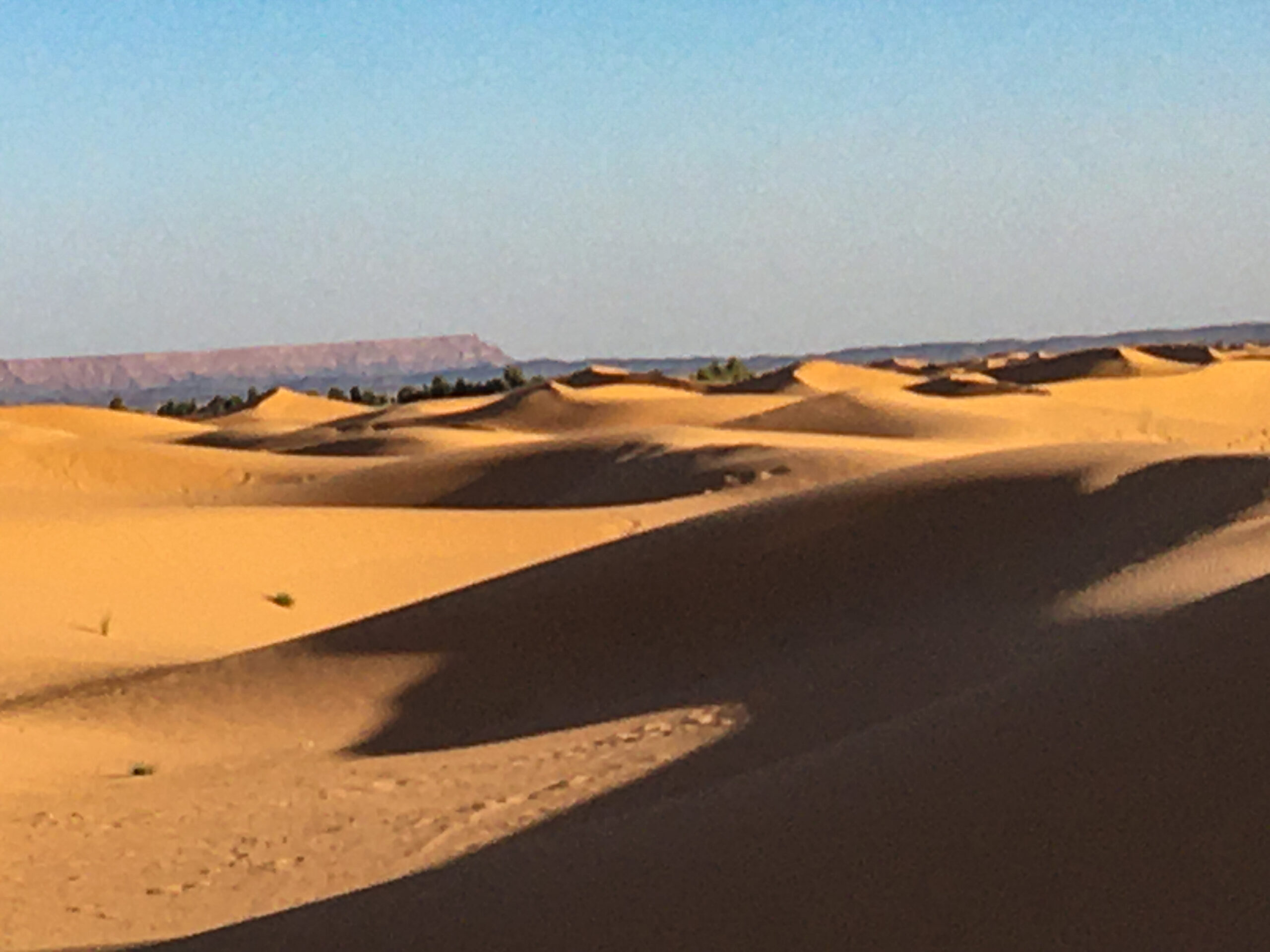
If you travel this far, it makes sense to leave the cities at least once and see the desert. The village of Merzouga stands beside Erg Chebbi, a field of dunes that change colour as the sun moves. You can cross the sand by camel or by four-wheel-drive vehicle, reach a desert camp, watch the sunset and spend the night away from the village lights. The light at sunrise and sunset is what gives the dunes their strongest colour, so plan around those hours rather than midday.
The seasonal lake of Dayet Srij, nearby, draws migratory birds when it holds water, so it is worth asking locally whether it is filled during your visit. If you can, add the town of Rissani to the same trip.
Kasbahs and gorges on the way
The route between the Sahara and Marrakech passes some of the most photogenic landscapes in the country. Aït Benhaddou is a fortified earthen settlement whose towers rise above the old caravan route, and its listed ksar has appeared in many films and television productions. Ouarzazate, close by, has film studios and the Taourirt Kasbah.
Further on, the Dadès Valley follows a ribbon of palms, fields and fortified villages between coloured rock. Todra Gorge narrows dramatically around a riverbed used by walkers and rock climbers.
- Go with a guide when heading into the dunes.
- Choose camel or vehicle depending on how much time you have and how authentic you want the crossing to feel.
- Allow extra driving time between the gorges, the kasbahs and the desert, since distances are large.
Where can you walk in the mountains and by the water?
The High Atlas is a landscape of steep slopes, deep valleys and terraced fields, with Amazigh villages clinging to the hillsides. Most walkers begin at Imlil, the usual gateway to Toubkal National Park and to Jebel Toubkal, the highest peak in North Africa. Options run from easy village strolls and treks supported by mules to tough climbs lasting several days, so you can match the plan to your fitness. Slot canyons, cliffs and valley trails also support activities such as rafting, kayaking and climbing for those who want something more active.
Water is a surprise in a country associated with desert. At Ouzoud, water drops in several stages through a red-rock gorge surrounded by olive groves and wooded slopes. Paths lead from the village down to viewpoints and pools below the falls, and small boats operate near the base when conditions allow. Barbary macaques live in the area, and the sensible approach is to watch them from a distance without feeding them. A warm day is the best time for a swim, and the afternoon light can bring rainbows from the spray.
Why head to the Atlantic and Mediterranean coasts?
Morocco’s coast gives a change of pace from the inland cities. Essaouira has stone ramparts, whitewashed houses and blue fishing boats. The Skala de la Ville offers views along the fortified seafront, and the harbour still works, with fishing vessels and seafood stalls. Strong coastal winds bring windsurfers and kitesurfers, and the town is closely tied to the Gnaoua musical tradition.
Agadir was largely rebuilt after the earthquake of 1960 and is now centred on a wide sandy beach, a seafront promenade and a marina. From the surviving walls of the hilltop Agadir Oufella you get panoramic views of the city and the bay. North along the coast, Taghazout, once a fishing village, has become the best-known surfing centre in the country.
In the far north, Tangier overlooks the Strait of Gibraltar and has long been a meeting point between Africa and Europe. Its medina climbs towards a hilltop kasbah that houses a museum, and west of town Cap Spartel and the Caves of Hercules face the point where the Atlantic meets the Mediterranean. Tétouan, further east, has a listed medina with clear Andalusian links, with whitewashed houses and tiled courtyards inside surviving sections of the old walls.
How do you enjoy everyday Moroccan life in any town?
Not everything worth doing is on a list of sights. Almost any Moroccan town gives you small, free ways to spend an afternoon, and they often make the trip feel more grounded.
- Visit a market. Large cities have lively medinas packed with handicrafts and food. Smaller towns tend to have open-air markets, and on the weekly market day people from the surrounding area come to buy and sell, so expect bicycles, donkeys carrying loads and dusty pick-up trucks.
- Spot the mosque. On a road trip, look for the square minaret that usually rises above everything else in a village. In larger cities the most decorated mosques are often among the main attractions.
- Sit in a café. Order mint tea and something to eat. Many cafés set their chairs facing the street, which makes for easy people-watching. Cafés that are mostly male are usually tolerant of women customers, even if you are the only one.
- Walk in a park. Depending on the hour, you may see families, teenagers or men absorbed in a game of checkers.
- Find a viewpoint. Hills on the edge of many towns overlook the old and new quarters. Where city walls are visible, early morning light makes them look especially warm.
- Try a hammam. Almost every town has one, and it is a good way to recover after a long journey.
Museums are uncommon in villages, though some small towns keep a modest display of local objects. Larger cities and popular routes tend to have more developed ones.
Planning your route
Morocco is big, and trying to see the whole country in one trip means a lot of time on the road. A more realistic plan is to pick two or three regions, for example Marrakech with the High Atlas, or Fez and Meknes with the Rif, and leave room for slow afternoons in cafés and markets.
Related reading
- Hello from Montreal – A Delicious Outside Lunch at the Cafe du Chateau, a Major Thunderstorm
- Visiting Malawi
Sources
- 6 things to do when you’re travelling in Morocco (travelguard.ca, accessed 2026-11-23)
- Attractions in Morocco (worldtravelguide.net, accessed 2026-11-23)
Photo: Erg Chebbi, Sahara Desert, Morocco, 摩洛哥 – 49678271948, by cattan2011, CC BY 2.0 (Wikimedia, via Openverse)